
Quick answer: Choose a tiller at least as wide as your tractor’s rear tire tracks and within its PTO horsepower range. Gear-driven tillers suit heavier, frequent use; chain-driven tillers cost less and suit lighter work. Reverse-tine (counter-rotating) tillers dig deeper into hard ground and break sod better, while forward-rotating tillers are easier on the tractor and work well in prepared soil.
What a three-point rotary tiller does
A rotary tiller is driven by the tractor’s power take-off (PTO). A rotor fitted with curved tines chops and mixes the soil, turning hard ground or residue into a fine, loose seedbed in fewer passes than a disc harrow. It is popular for gardens, food plots, landscaping and small-farm seedbeds.
Gear drive vs chain drive
| Drive | Strengths | Consider |
|---|---|---|
| Gear drive | Sealed gear case, high torque capacity, low maintenance | Higher price and weight |
| Chain drive | Lower cost, lighter, easier to lift with small tractors | Chain tension and lubrication need checking |
Our farm and acreage range includes gear-driven forward and reverse-tine tillers from 4 to 6 ft and a chain-driven tiller for compact tractors.
Forward vs reverse tine
- Forward rotation: Tines turn in the same direction as the tractor’s wheels. The tiller helps pull itself forward, which is easier on smaller tractors. It is good for working previously tilled soil.
- Reverse rotation (counter-rotating): Tines turn against the direction of travel, digging deeper and burying residue. It is better for breaking sod and hard ground, but needs more horsepower and a steady ground speed.
Matching the tiller to your tractor
- Width: The tiller should cover the outside of the rear tires, so you do not leave compacted wheel tracks.
- PTO horsepower: Stay within the tiller’s recommended range. An under-powered tractor bogs down; an over-powered one can overload the tiller.
- PTO speed: Most tillers run at 540 RPM. Confirm your tractor’s PTO speed.
- Hitch: Category 1 is common on compact and small utility tractors.
- Lift capacity: Make sure the three-point hitch can lift the tiller; add front ballast if steering becomes light.
Driveline protection
Hitting a rock or root can stop the rotor suddenly. Tillers use a shear bolt or a slip clutch to protect the gearbox and tractor. Shear bolts break and must be replaced with the correct grade; slip clutches slip under overload and need periodic adjustment. Use the PTO shaft guards supplied and keep them in place.
Tilling tips
- Work when the soil is moist but not wet; wet soil forms clods and compacts.
- Start shallow on hard ground and go deeper with later passes.
- Adjust the rear shield to control how fine the soil finish is.
- Use a slow ground speed with full PTO speed for a finer seedbed.
- Remove large rocks and roots first where possible.
Frequently asked questions
Should I till or disc?
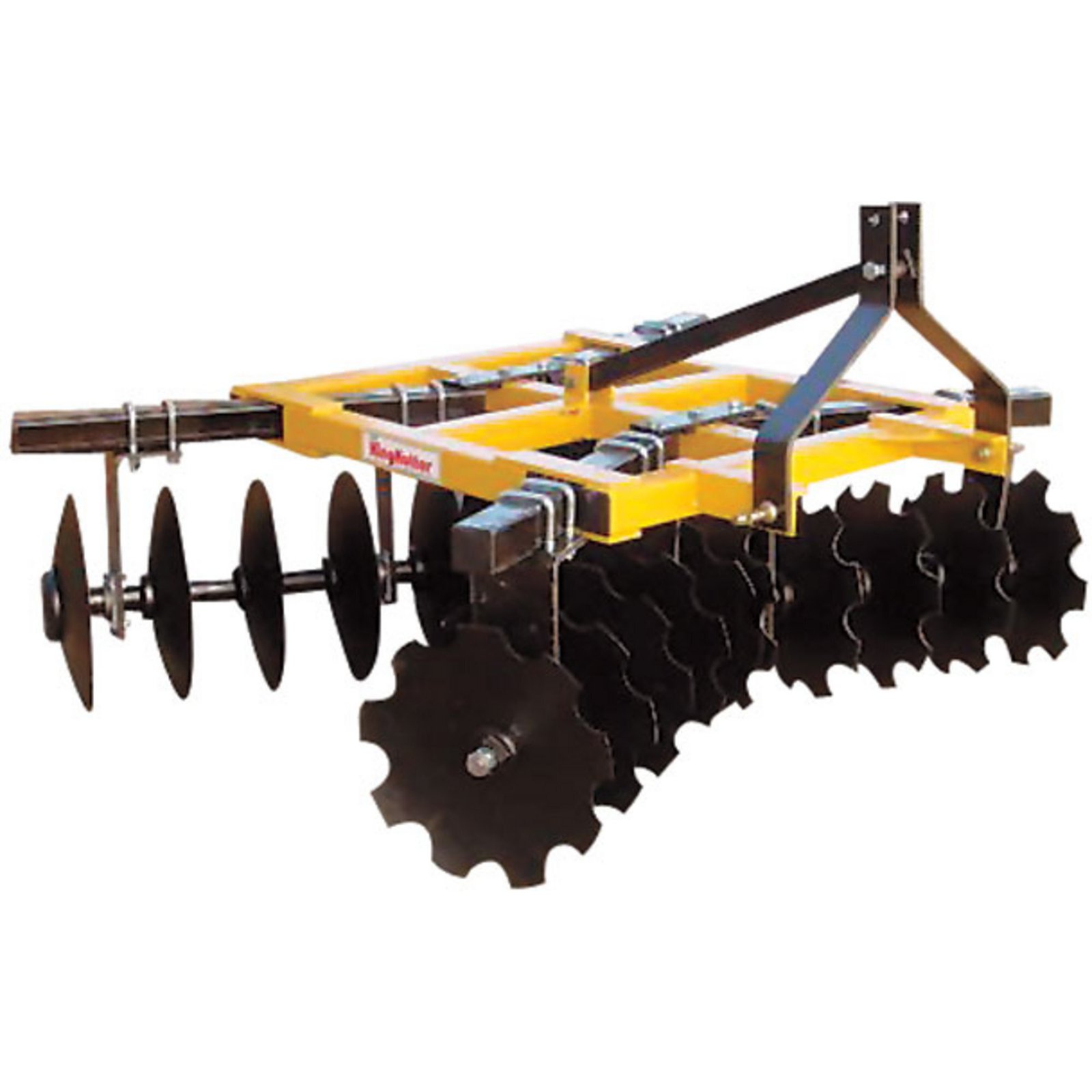
Discing covers large areas faster with less horsepower. Tilling produces a finer seedbed in fewer passes on smaller areas. See our disc harrow guide.
Can a tiller break new ground?
A reverse-tine gear-driven tiller handles new ground better than a forward-tine unit, but very hard or rocky ground may need ripping or discing first.
How do I maintain the tiller?
Check gearbox oil, grease fittings and PTO shaft, inspect tines and bolts, and clean the rotor after use.
Share your tractor model, PTO horsepower and soil conditions, and we will help you choose a tiller.