
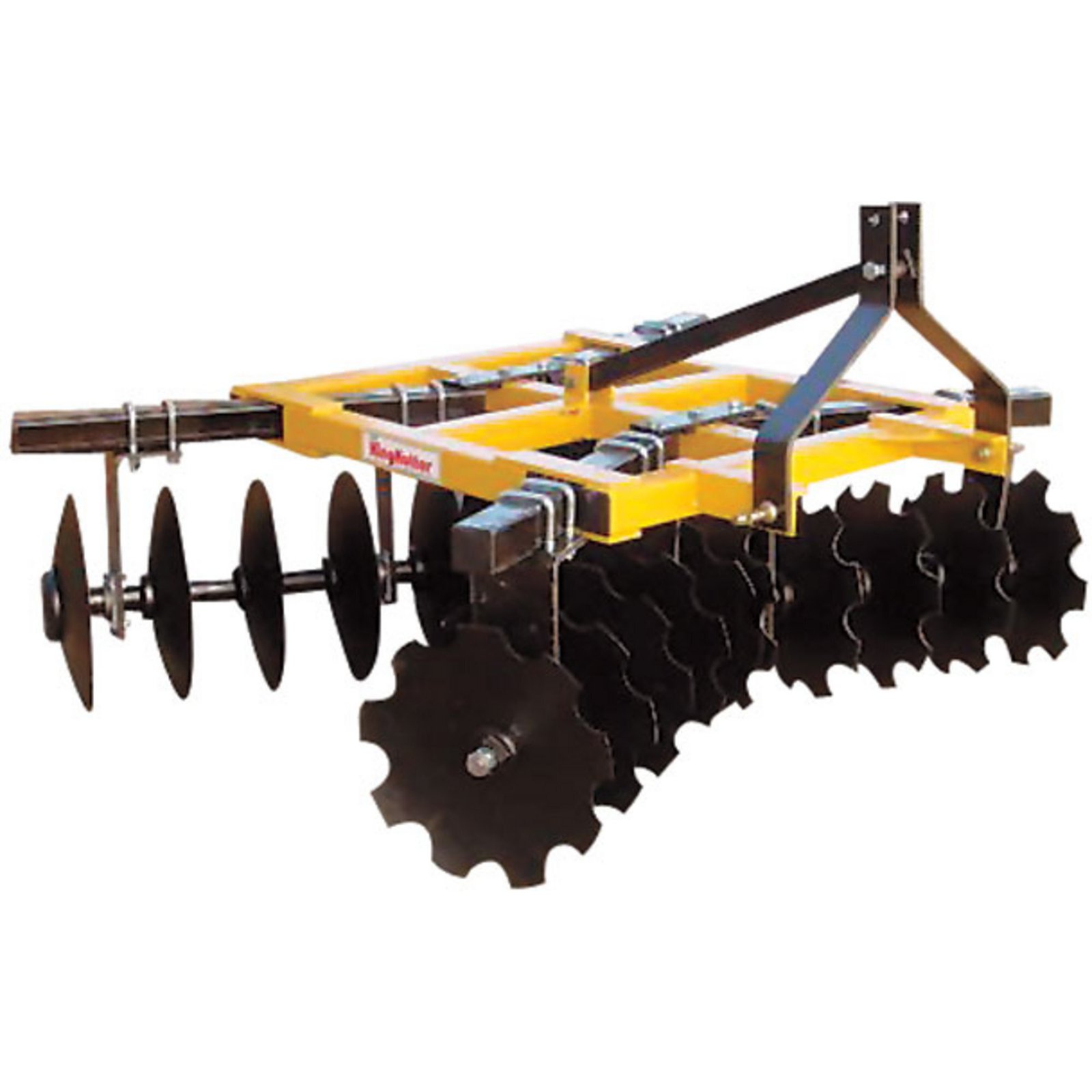
Quick answer: Notched blades cut through residue, sod and hard ground; smooth blades finish and level soil; a combination harrow (notched front, smooth rear) does both in one pass. Angle-frame harrows suit lighter tractors and general work, while box-frame harrows are heavier and stiffer for tougher ground. Choose a width that covers your tractor’s tire tracks and suits its horsepower and lift capacity.
What a disc harrow does
A disc harrow uses gangs of concave steel discs set at an angle to the direction of travel. As the tractor pulls the harrow, the discs cut, lift and turn the soil, breaking up clods, chopping crop residue and preparing a seedbed. Three-point hitch harrows are the common choice for compact and utility tractors on small farms and acreages.
Blade types
| Blade | Strength | Common use |
|---|---|---|
| Notched (cutout) | Bites into hard ground and slices residue and sod | Breaking new ground, cutting stalks, primary work |
| Smooth (plain) | Leaves a finer, more even finish | Seedbed preparation, leveling |
| Combination | Notched front gang cuts; smooth rear gang finishes | One-pass work on mixed ground |
Angle frame vs box frame
- Angle frame: Lighter construction from angle iron. Easier for small tractors to lift, and lower cost. It suits gardens, food plots and previously worked ground.
- Box frame: Built from square tubing, heavier and more rigid. The extra weight helps the discs penetrate firm soil, and the frame resists flexing under load.
Our farm and acreage range includes notched and combination disc harrows in angle-frame and box-frame designs, mainly in 6-1/2 ft and 7-1/2 ft widths.
Matching the harrow to your tractor
- Hitch category: Most compact and small utility tractors use a Category 1 three-point hitch. Confirm the harrow’s hitch category.
- Width: The harrow should be at least as wide as the outside of the rear tires so you do not leave packed wheel tracks.
- Horsepower range: Check the recommended tractor horsepower in the product specifications.
- Lift capacity: Make sure the tractor’s three-point lift can raise the harrow’s weight at the lift points, and add front ballast if needed for steering control.
Adjustments that improve results
Most harrows let you change the angle of each gang. A sharper angle cuts deeper and more aggressively; a shallower angle leaves a smoother finish. Adjust the top link so the harrow runs level front to back, and make passes in different directions on rough ground. Speed matters too: going too fast can make the harrow ride over hard spots instead of cutting.
Care and maintenance
- Grease bearings according to the manual, or check sealed bearings for play.
- Check gang bolts and frame bolts for tightness after the first hours of use.
- Clean off mud and residue after use and store the harrow under cover.
- Inspect blades for cracks and wear; replace worn or damaged blades in sets where needed.
Frequently asked questions
Can a disc harrow break sod by itself?
A heavy notched harrow can break sod with several passes, but very tough sod often benefits from plowing or tilling first.
Disc harrow or rotary tiller?
Harrows cover ground faster and need less horsepower per foot of width. Tillers produce a finer seedbed in fewer passes. See our tiller guide in the Farm Equipment section for comparison.
Can I add weight to a harrow?
Some frames have provisions for added weight. Only add weight if the manufacturer allows it and your tractor can lift it safely.
Share your tractor model, horsepower and soil type, and we will help you pick a harrow width and frame.