
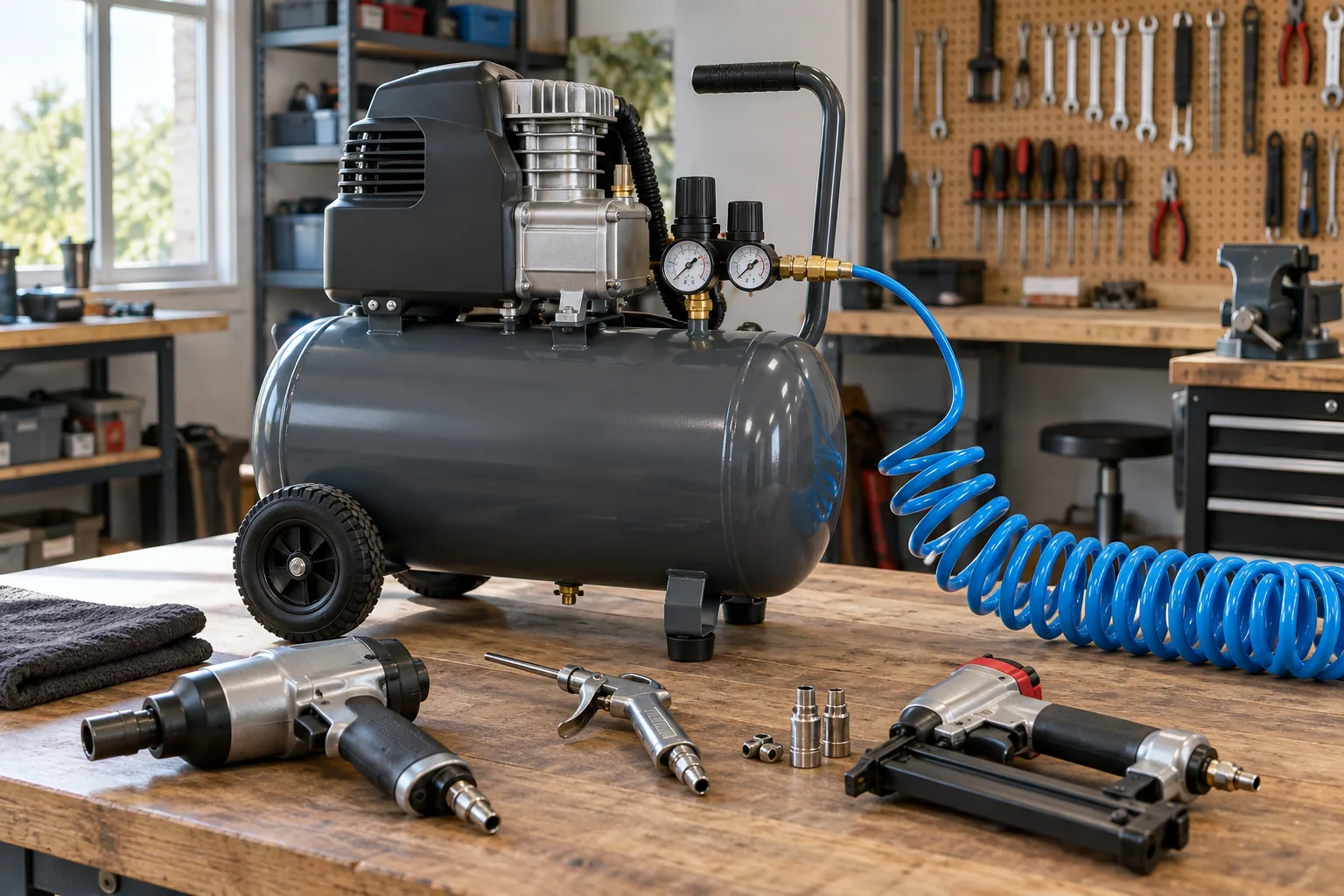
Quick answer: A rotary screw compressor suits shops where air is needed for most of the working day, because it is built to run continuously. A piston (reciprocating) compressor suits intermittent use, where the compressor fills the tank, rests, and runs again. The deciding factor is usually how many hours per day your tools actually draw air.
How each compressor makes air
A piston compressor works much like an engine running in reverse. A crankshaft drives one or more pistons that draw air into a cylinder and push it into a receiver tank. Two-stage models compress the air twice for higher pressure. The pump starts and stops on a pressure switch, so it cycles on and off as the tank pressure rises and falls.
A rotary screw compressor uses two meshing helical rotors. As the rotors turn, air is trapped between the lobes and squeezed toward the outlet in a smooth, continuous flow. Most shop screw compressors are oil-flooded: oil cools, seals and lubricates the rotors and is then separated from the air before it leaves the package.
Side-by-side comparison
| Factor | Piston compressor | Rotary screw compressor |
|---|---|---|
| Intended duty | Intermittent; needs rest periods (check the stated duty cycle) | Designed for continuous running |
| Noise | Louder, with pulsing sound | Smoother and usually quieter, often in an enclosed cabinet |
| Purchase price | Lower at the same horsepower | Higher |
| Air temperature | Hotter discharge air, more moisture to manage | Cooler, steadier output when fitted with an aftercooler |
| Typical fit | Tire shops, small garages, occasional blasting or impact work | Production lines, body shops, multi-bay garages, manufacturing |
| Weak spot | Overheating and wear if run near-constantly | Inefficient if it spends most of its time lightly loaded |
Start with your daily run time
Track how long your current compressor runs during a normal day. A simple way is to note the time the pump runs in a typical hour, then repeat at a busy time. If the compressor runs only in short bursts, a piston unit is usually the practical choice. If it runs most of the hour, or several people use air at the same time, a screw compressor is worth comparing.
Running a piston compressor beyond its intended duty cycle shortens the life of valves, rings and the motor. Running a large screw compressor at very low demand has the opposite problem: it spends long periods unloaded, using power without delivering much air. Matching the compressor to the real load is what keeps operating cost down.
Check air demand in CFM, not horsepower
Horsepower tells you the motor size, not how much air reaches your tools. Compare delivered CFM at the pressure your tools need, usually 90 to 125 PSI. Add up the CFM of the tools that run at the same time, then allow some extra capacity for leaks and future growth. Our guide to CFM vs PSI explains why both numbers matter.
As an example, the rotary screw models in our rotary screw air compressor range list output from roughly 28 CFM on 7.5 HP units to over 100 CFM on 25–30 HP units. Always read the CFM figure together with the pressure it was measured at.
Power supply and installation
- Electrical: Many screw compressors from about 10 HP upward need three-phase power. Confirm the voltage (for example 208, 230 or 460V) and phase on the product listing before ordering.
- Space and airflow: Both types produce heat. Leave the clearance stated in the manual and make sure the room has ventilation so the compressor does not breathe its own hot exhaust.
- Treatment: Plan for a dryer and drains. Some screw packages include a dryer and receiver tank in one unit, which simplifies installation.
- Delivery: Screw compressors are heavy freight items. Plan unloading and placement in advance; see our notes on preparing for heavy equipment delivery.
Maintenance differences
Piston compressors need regular oil checks and changes on lubricated pumps, intake filter cleaning, belt tension checks and valve service over time. Screw compressors need scheduled changes of the oil, oil filter, air filter and air/oil separator element at the hour intervals listed by the manufacturer. Neither type is maintenance-free, so factor service parts and labour into the running cost.
Quick decision checklist
- Air needed most of the shift, or by several users at once: compare rotary screw models.
- Air needed in short bursts, by one or two users: a piston compressor is usually enough.
- No three-phase power: check single-phase screw models or stay with piston units.
- Noise is a concern near work areas or offices: screw compressors in cabinets are usually easier to live with.
Frequently asked questions
Can a rotary screw compressor run all day?
They are designed for continuous duty, but they still need correct ventilation, clean filters and scheduled service. Follow the operating limits in the manual.
Is a rotary screw compressor always more efficient?
Not always. At steady, high demand they are generally efficient. At very low or occasional demand, a correctly sized piston compressor can cost less to run.
Do I still need a receiver tank with a screw compressor?
Yes, in most systems. A receiver tank stores air, smooths out demand peaks and reduces how often the compressor loads and unloads.
Not sure which side of the line your shop falls on? Send us your tool list and daily usage and our team will help you compare models.