
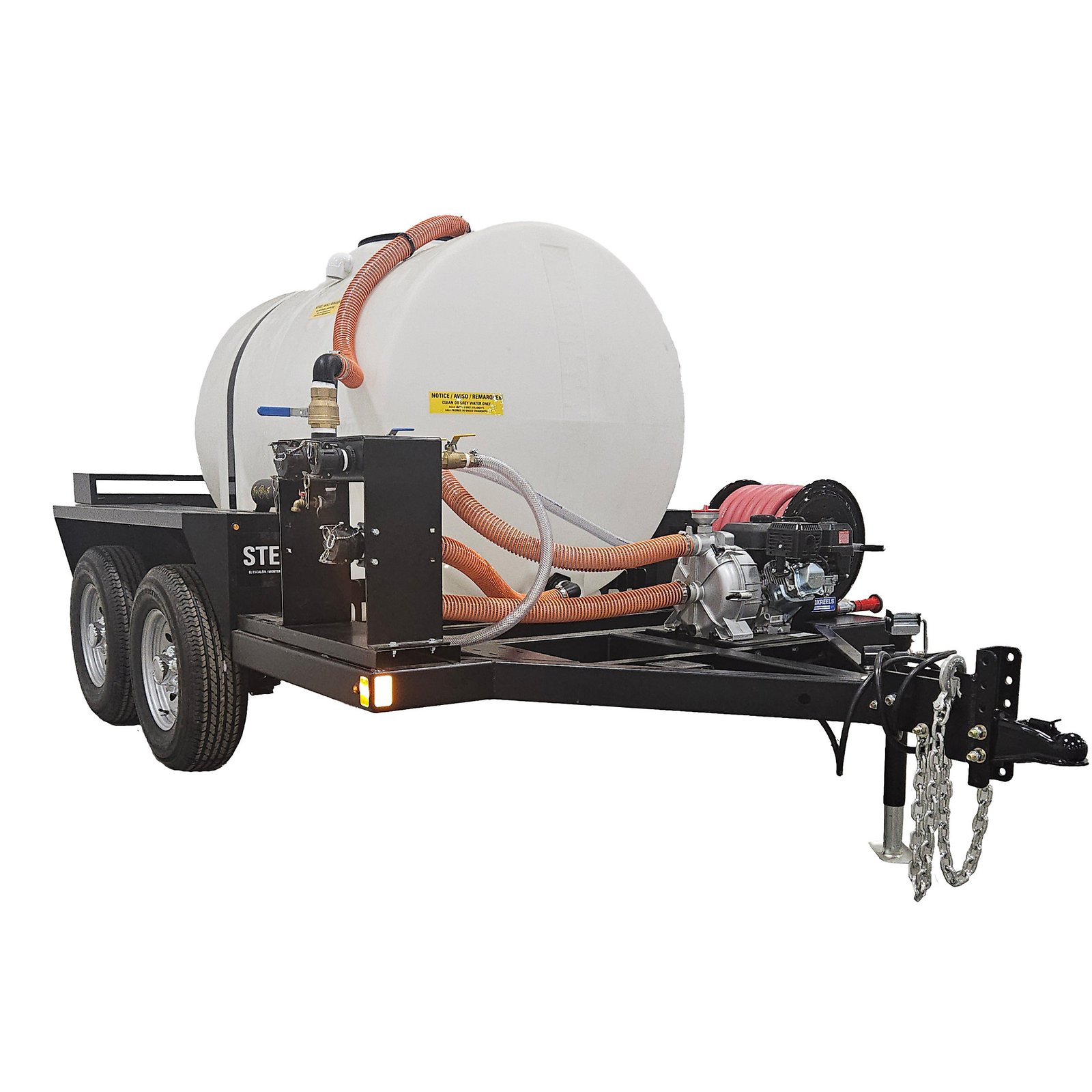
Quick answer: When there is no water connection on site, a pressure washer trailer carries its own water tank. Divide the tank volume by the machine’s GPM to get runtime: a 150-gallon tank feeding a 4 GPM washer lasts about 37 minutes, while a 525-gallon tank feeding a 7 GPM unit lasts about 75 minutes. Plan refills, trailer weight and towing capacity around that number.
Who needs a mobile cleaning rig
Mobile pressure washing serves fleets parked at customer yards, construction equipment on site, farms, livestock trailers, and exterior surfaces where water access is limited. A self-contained trailer or skid setup lets the operator arrive with water, power and hot water ready to work.
Runtime calculation
Runtime (minutes) = Usable tank volume (gallons) ÷ Pressure washer flow (GPM)
| Tank | 4 GPM | 5.5 GPM | 7 GPM |
|---|---|---|---|
| 150 gal | ~37 min | ~27 min | ~21 min |
| 325 gal | ~81 min | ~59 min | ~46 min |
| 525 gal | ~131 min | ~95 min | ~75 min |
Runtime counts only spraying time; triggers off between passes extend the working period. Leave some water in the tank so the pump does not run dry.
Trailer, skid or truck-mount
- Complete trailer: Tank, pressure washer, hose reels and storage on one trailer. Ready to tow and work.
- Skid unit: A pressure washer on a frame that you install on a truck bed or your own trailer, often with two wands for two operators.
- Truck-mount washer: Compact unit bolted into a truck bed, fed from a separate tank.
- Water trailer: A large-capacity water tank with its own transfer pump for dust control, filling other tanks or supplying multiple machines.
Our pressure washer range includes complete hot water and cold water trailers, multi-wand skids, truck-mount units and water trailers with trash pumps.
Weight and towing
Water weighs about 8.3 lb per US gallon. A 525-gallon tank holds over 4,300 lb of water alone, before the trailer, machine and fuel. Check the trailer’s gross vehicle weight rating and your tow vehicle’s towing and tongue weight limits. Partially filled tanks can slosh; baffled tanks reduce this. Follow local trailer brake and registration rules.
Hot water on the road
Many mobile rigs use hot water units for grease and oil on fleet and equipment cleaning. Plan space for burner fuel, and keep the burner exhaust away from the water tank and hoses. Our hot vs cold water guide explains when heat is worth it.
Wastewater and chemicals
Many jurisdictions restrict letting wash water containing oil, detergents or solids flow into storm drains. Depending on the job, you may need recovery mats, berms or a vacuum recovery system. Use detergents suitable for the surface and allowed for discharge where you work.
Freeze protection
In cold climates, drain the tank, pump, hoses and heating coil after use, or run a pump antifreeze through the system following the manufacturer’s instructions. Water trapped in a pump or coil can crack castings when it freezes.
Frequently asked questions
Can I fill the tank from any water source?
Use clean water and an inlet filter. Debris and sand quickly wear pump valves and seals.
Should I use a buffer tank even with a hydrant?
A buffer tank helps when supply pressure or flow is inconsistent, and some areas require backflow prevention when connecting to mains.
How many hose reels do I need?
One reel per operator, plus a water fill hose. Long reels let you reach vehicles without moving the trailer.
Tell us your typical jobs and towing vehicle, and we will help you plan a mobile washing setup.