Quick answer: For motorcycles, a 1,000–1,500 lb lift table covers most street and touring bikes. ATVs and UTVs need wider, longer decks and often 2,000 lb or more. Air/hydraulic tables run from a shop compressor, while electric/hydraulic tables need only a power outlet. Check lift range, deck size, ramp, wheel vise and lock positions before buying.
Why use a lift table
Working on a bike or ATV at floor level means hours of kneeling and bending. A lift table raises the vehicle to a comfortable working height, typically around waist height, and holds it on mechanical locks. It also makes it easier to remove wheels, swingarms and exhaust systems and to keep the vehicle stable while you work.
Power options compared
| Type | How it lifts | Strengths | Consider |
|---|---|---|---|
| Air-powered | Air bag or air cylinder | Simple and quick | Needs a compressor |
| Air/hydraulic | Air drives a hydraulic pump | Smooth, controlled lift; common in workshops | Needs a compressor |
| Electric/hydraulic | Electric motor drives a hydraulic pump | No compressor needed; often remote controlled | Needs a suitable outlet |
| Manual hydraulic | Foot pump | No power needed | Slower lifting |
Specifications to check
- Capacity: Choose comfortably above the vehicle’s weight, including fluids and accessories.
- Lift range: Low minimum height makes loading easier; maximum height (often 30–47 in.) sets the working position.
- Deck length and width: Long-wheelbase touring bikes need longer decks; ATVs and UTVs need wide decks or adjustable width.
- Ramp: Fixed, removable or retractable ramps affect loading and floor space.
- Wheel vise: Holds the front wheel to keep a motorcycle upright.
- Drop-out panel: A removable rear section lets you remove the rear wheel without lifting the bike further.
- Locks: Multiple lock positions let you choose working heights.
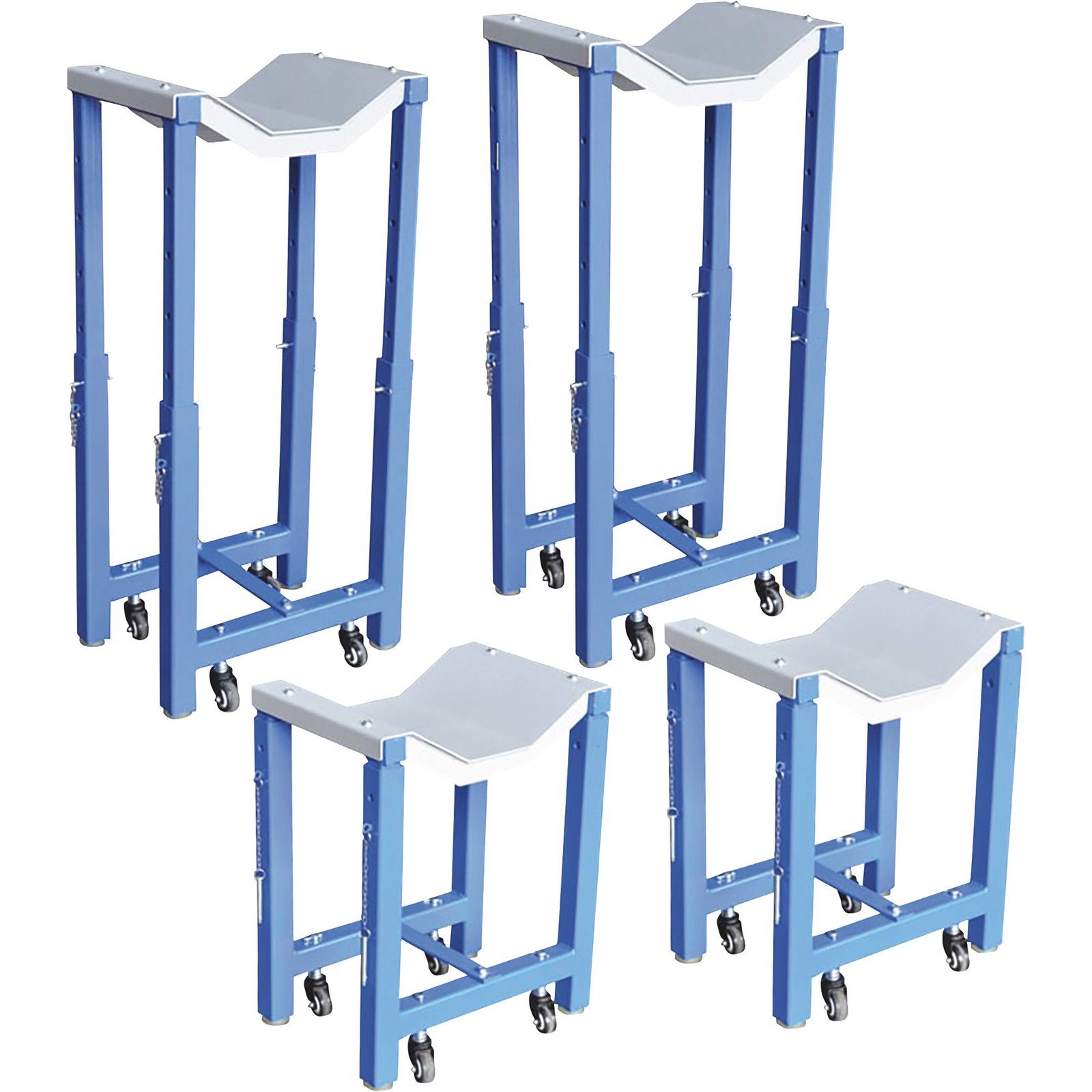
Our motorcycle and ATV lift range includes air, air/hydraulic and electric lift tables from 1,000 to 2,500 lb, plus wheel stand kits.
Motorcycle vs ATV/UTV tables
Motorcycle tables are narrow and long, designed around a single track. ATV and UTV tables are wide platforms, sometimes with side extensions, and need more floor space. Some tables handle both with extension kits, but check that the deck width and capacity suit your largest vehicle. Frame-engaging UTV lifts are another option when you need the wheels to hang free.
Space planning
Allow the table length plus the ramp, and space to walk around the vehicle. Many lift tables have casters or a dolly so they can be moved and stored against a wall. Use the table only on a level, solid floor.
Safe use
- Secure the bike with the wheel vise and tie-down straps before lifting.
- Always lower onto a mechanical lock before working.
- Keep the load centered on the deck.
- Be careful when removing heavy components, which shifts the center of gravity.
Frequently asked questions
What capacity do I need for a touring motorcycle?
Heavy touring bikes can weigh 800–900 lb or more fully fueled. A 1,500 lb table gives a reasonable margin.
Can I use a car lift for motorcycles?
Some car lifts accept motorcycle adapters, but a dedicated table is usually more stable and convenient.
Do air lift tables need a big compressor?
Not usually. They need the stated pressure; a typical shop compressor is enough. Check the table’s air requirement.
Tell us what you ride and the size of your workspace, and we will help you choose a lift table.