
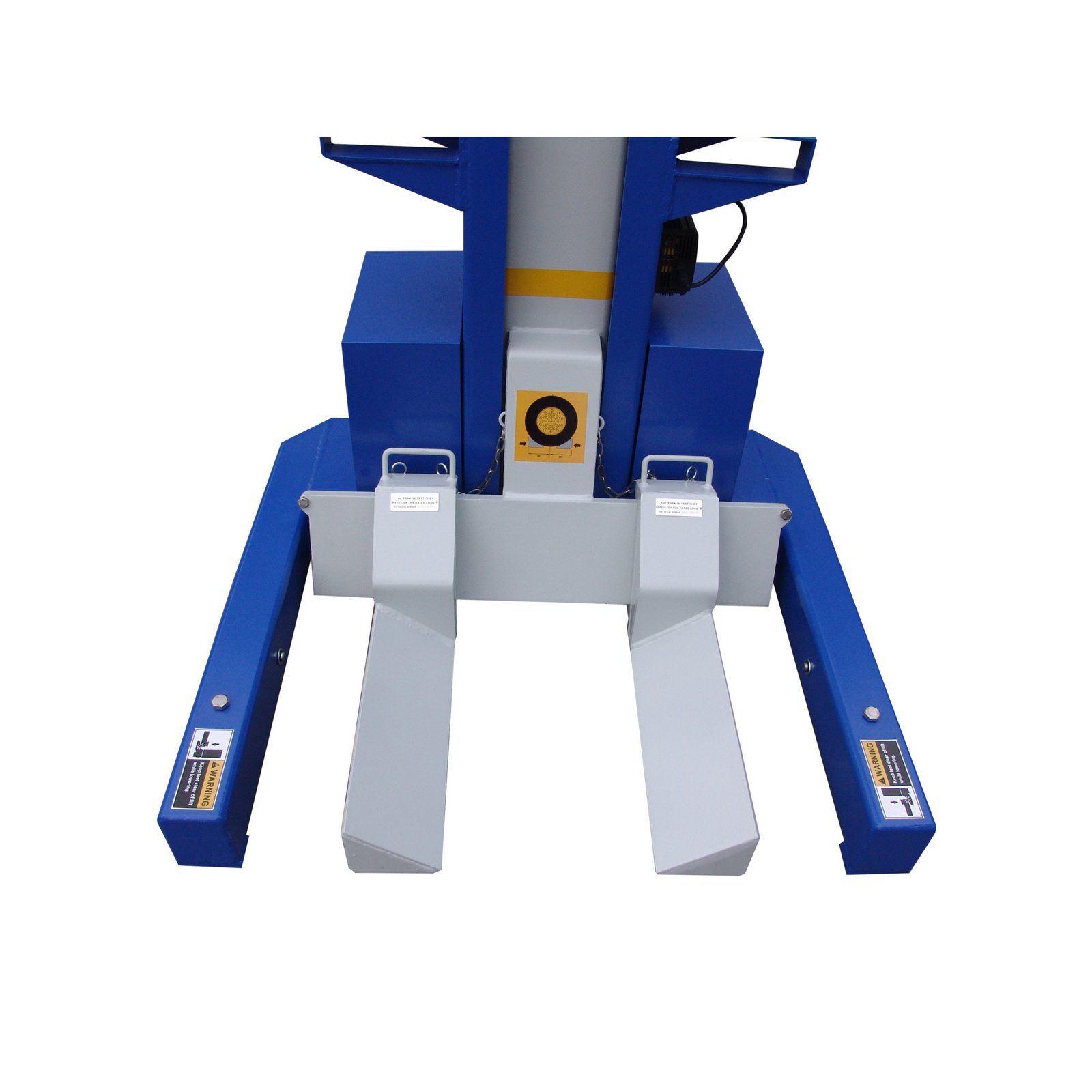
Quick answer: Mobile column lifts are individual lifting columns that roll under each wheel of a heavy vehicle and lift together in sync. Sets of two lift one end or a light vehicle; sets of four lift most two-axle trucks and buses; sets of six or more handle three-axle vehicles. Total capacity is the per-column rating multiplied by the number of columns, but each column must stay within its own rating.
How mobile column lifts work
Each column has a pair of forks or a wheel-engaging carriage that slides under a tire. The columns are rolled into position with a built-in pallet-jack style handle, then connected by cable or wireless link to a control system that raises all columns at the same rate. Mechanical locks hold the load at working height. Because nothing is anchored to the floor, the bay can be used for other work when the columns are parked.
Choosing the number of columns
| Set | Typical use |
|---|---|
| 2 columns | Lifting one axle end, light commercial vehicles, or as a starter set expandable later (check compatibility) |
| 4 columns | Most two-axle trucks, buses, RVs and loaders |
| 6 columns | Three-axle trucks, long buses and articulated equipment |
| 8+ columns | Multi-axle vehicles, where the system allows it |
Example: four columns rated at 18,000 lb each give a 72,000 lb set capacity, but no single wheel position may exceed 18,000 lb. Heavy front axles on some trucks may need checking against the per-column rating.
Power options
- Corded AC: Each column connects to shop power. They work with unlimited duty, but need outlets near the bay and create cables on the floor.
- Battery (often 24V or low-voltage DC): No power cables during use, easy to move between bays and outdoors where permitted. Batteries need charging.
- Wireless or cabled sync: Wireless systems remove control cables between columns; cabled systems are simple and do not depend on radio signals.
Our single-post and mobile column lift range includes sets of two, four and six columns, mobile single columns and air-operated end lifts.
Floor requirements
Mobile columns place heavy loads on small areas of floor. Manufacturers specify a minimum concrete thickness and strength, a maximum floor slope and a smooth, level surface. Uneven floors can cause columns to lift out of sync. Check the manual before using columns outside the main workshop floor.
Accessories worth considering
- Jack stands: High-capacity stands rated for the load let you free the columns for another vehicle.
- Wheel adapters: For small wheels or special tire sizes.
- Extra columns: If the system allows expansion, you can grow from a set of four to six.
Alternatives for smaller fleets
If you only need to raise one end of a heavy vehicle for tire or brake work, an air-operated end lift or heavy-duty jack may be enough. For passenger vehicles and light trucks in a fixed bay, a two-post lift or four-post lift is usually simpler.
Frequently asked questions
Can I mix columns from different sets?
Only if the manufacturer confirms they are compatible. Columns must communicate and lift in sync.
Can mobile columns be used outdoors?
Some systems allow outdoor use on suitable concrete in dry conditions. Check the manual for environmental limits.
Do mobile column lifts need training?
Yes. Operators should be trained on positioning, sync checks, lock use and emergency lowering, as described in the manual.
Tell us your heaviest vehicle, axle weights and bay layout, and we will help you size a column lift set.