
Quick answer: Multiply the room’s volume in cubic feet by the number of air changes per hour you want, then divide by 60. The result is the CFM your exhaust fan needs to move. For example, a 40 × 60 ft shop with 16 ft walls (38,400 cu ft) at 6 air changes per hour needs about 3,840 CFM, before allowing for static pressure.
The basic formula
Required CFM = (Length × Width × Height × Air changes per hour) ÷ 60
Air changes per hour (ACH) is how many times the full volume of air in the room is replaced every hour. A higher ACH removes heat, fumes and dust faster.
Typical air change rates
These ranges are common starting points for general ventilation. Your local building code, fire code or occupational safety rules may require specific rates, and process ventilation such as welding fume extraction or spray booths is designed separately.
| Space | Common starting range (ACH) |
|---|---|
| Warehouse or storage | 2–6 |
| General workshop or garage | 4–10 |
| Hot manufacturing area | 10–20 or more |
| Livestock or poultry building | Varies widely with season and animal load |
Worked example
- Room size: 50 ft × 80 ft × 18 ft = 72,000 cu ft
- Target: 8 air changes per hour
- 72,000 × 8 = 576,000 cu ft per hour
- 576,000 ÷ 60 = 9,600 CFM
You could meet that with one large fan or split it across two or more smaller fans on different walls to spread airflow more evenly.
Adjust for static pressure
Fan CFM ratings change with resistance to airflow, measured as static pressure in inches of water. Shutters, louvers, insect screens, ducts and filters all add resistance. A fan rated at a given CFM at 0 in. static pressure will move less air at 0.125 or 0.25 in. When comparing fans, look at the performance table and read the CFM at the static pressure your installation is likely to have.
Do not forget make-up air
An exhaust fan can only remove air if the same amount of air can come in. Without enough inlet area, the building goes into negative pressure, the fan moves less air, doors become hard to open and fuel-burning heaters can backdraft. Provide intake louvers, open doors on the opposite wall, or a filtered fresh air supply unit that brings in clean air. As a rough guide, inlet area should be sized for the total exhaust CFM at low air velocity.
Belt drive vs direct drive
- Belt drive: Common on large wall fans. Pulley sizes can be set for the required speed, and the motor sits out of the main airstream. Belts need periodic tension checks and replacement.
- Direct drive: The blade is mounted on the motor shaft. They have fewer moving parts and less maintenance, and are common on small and medium fans.
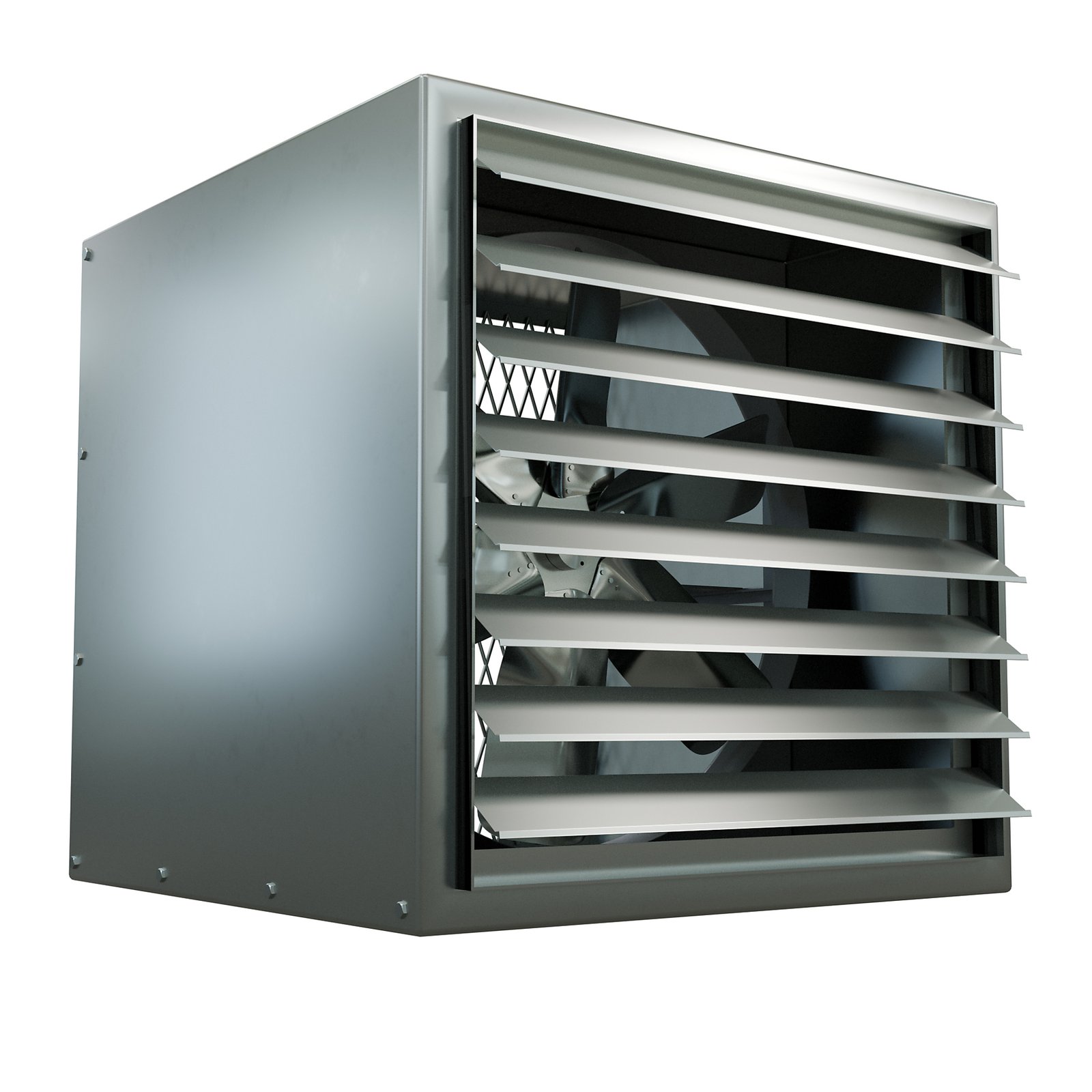
Our industrial fan range includes belt and direct drive cabinet wall exhaust fans in 24 to 48 in. sizes, fresh air supply units and inline duct blowers.
Placement tips
- Exhaust high on the wall to remove hot air that collects near the roof.
- Place intakes on the opposite side so air sweeps across the work area.
- Keep exhaust fans away from intakes so you do not recirculate the same air.
- Check single-phase or three-phase power and motor voltage before ordering.
Frequently asked questions
Is more ACH always better?
Not necessarily. Very high rates raise heating and cooling costs and can cause drafts. Size for the job and adjust with speed control or multiple fans.
Can I use an exhaust fan for welding fumes?
General ventilation helps, but fume extraction at the source is usually needed. Follow local occupational safety rules.
Does the CFM rating include the shutter?
It depends on how the manufacturer tested the fan. Check whether the rating is with or without shutters and guards.
Send us your building dimensions and use, and we will help you shortlist exhaust and supply fans.