
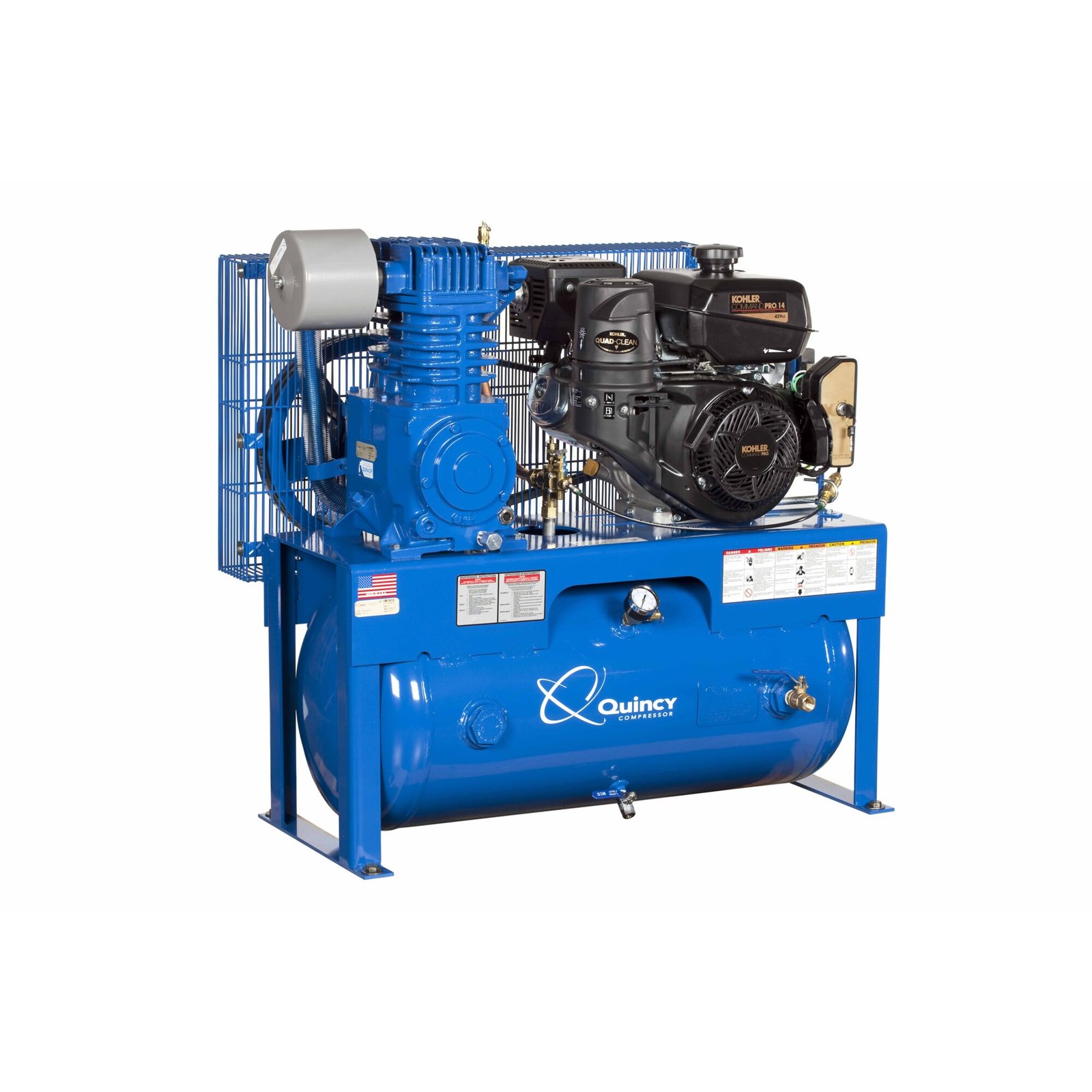
Quick answer: A truck-mount gas compressor with a 30-gallon tank suits service trucks that need air at every stop. A skid-mount (tankless or small-tank) unit saves space on a body or trailer. A wheelbarrow compressor suits contractors who move air around a job site. In all cases, compare delivered CFM at 90 PSI, the pump type and the engine’s starting method.
When a gas compressor makes sense
Gas engine compressors deliver air where there is no reliable power supply: roadside tire service, fence and framing work, farm repairs, pipeline and utility jobs. They also free a service truck from running a generator just to power an electric compressor. Because they burn fuel, they must only run outdoors or in a well-ventilated open space, never in a closed garage or enclosed truck body.
Mounting styles compared
| Style | Description | Typical use |
|---|---|---|
| Truck-mount (tank-mounted) | Engine and pump on a horizontal tank, often 30 gallons, bolted to a truck bed | Service trucks, tire service, fleet maintenance |
| Skid-mount | Engine and pump on a frame without a large tank | Truck bodies, trailers or installations with an existing receiver tank |
| Wheelbarrow | Twin small tanks on a wheeled frame with handles | Moving air around construction sites |
| Portable tank | Small to medium tank, engine and pump on a frame or wheels | General contractors and farms |
Browse stationary and truck-mount gas air compressors and portable gas air compressors to compare layouts.
Single-stage vs two-stage pumps
A single-stage pump compresses air in one stroke and is common on smaller wheelbarrow and portable units. A two-stage pump compresses air in two cylinders, reaching higher pressures (often 175 PSI) and storing more usable air in the same tank. For impact wrenches on truck tires and continuous tool use, two-stage pumps are the usual choice.
Specifications that matter
- Delivered CFM at 90 PSI: The most useful number for comparing real output. Our guide on sizing a compressor for air tools shows how to add up demand.
- Engine size and brand: Engine horsepower drives the pump, but CFM is what matters at the tool.
- Electric start: Saves effort on larger engines and in cold weather; requires a battery.
- Idle control or unloader: Lets the engine idle when the tank is full, reducing fuel use and noise.
- Tank size: A larger tank buffers short bursts, such as running an impact wrench.
- Weight and footprint: Check against your truck’s payload and bed space.
Installing on a service truck
- Bolt the compressor to the bed or body using the mounting points and hardware recommended by the manufacturer.
- Route exhaust away from the cab and from any enclosed compartments.
- Leave room for checking oil, draining the tank and servicing filters.
- Use a hose reel and correctly rated hose for the compressor’s maximum pressure.
Maintenance basics
Gas compressors need both engine and pump service: engine oil, air filters and spark plugs on the engine side; pump oil, intake filters, belt tension and valve checks on the compressor side. Drain the tank after each use to remove condensate. See equipment maintenance basics for a general routine.
Frequently asked questions
Can I run a gas compressor inside a workshop?
No. Engine exhaust contains carbon monoxide. Run gas compressors outdoors or in open, well-ventilated areas only.
Is a 30-gallon tank enough for truck tire work?
Often, when paired with a two-stage pump of adequate CFM. Heavy, continuous use may need more CFM rather than a bigger tank.
Should the compressor have electric start?
It is recommended for larger engines and frequent starts. Pull-start models are lighter and do not need a battery.
Tell us your truck, tools and daily use, and we will help you compare gas compressor options.