
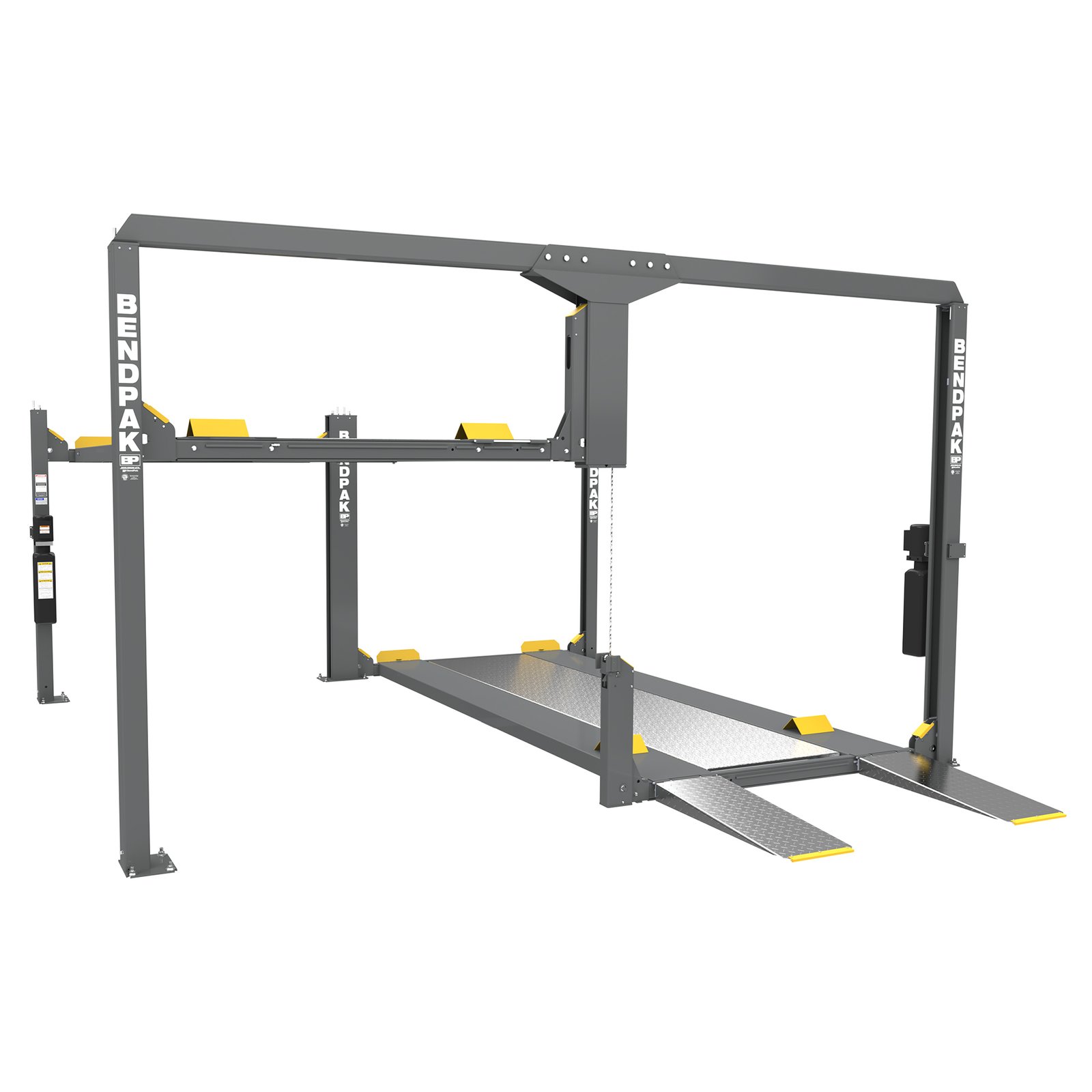
Quick answer: For parking and storage, choose a four-post lift sized for your heaviest vehicle with enough rise to fit a second vehicle underneath, and consider casters if you may move it. For service work, add rolling jacks so wheels can hang free, and look for wider or longer runways, heavier capacity, or an alignment-ready model if you do suspension work.
Why choose a four-post lift
A four-post lift has two drive-on runways supported by four columns. You drive on, set the parking brake and raise the vehicle; there are no arms to position under lifting points. That makes it quick, stable and well suited to stacking vehicles, long-term storage and jobs such as oil changes and exhaust work. Many four-post lifts are freestanding and do not need to be anchored, but always follow the installation manual.
Storage and parking setups
- Standard storage lift: Stacks one vehicle above another. Check the rise height and the clearance needed for the lower vehicle’s roof.
- Tandem or double-wide lifts: Hold two vehicles side by side or with independent platforms, saving floor space in larger garages.
- Tri-level lifts: Store three vehicles vertically in tall buildings.
- Extra-tall lifts: Extended rise for taller vehicles or for stacking a truck or boat.
Service-oriented features
- Rolling jacks: Bridge jacks that ride on the runways and lift the vehicle off its wheels for brake, tire and suspension work.
- Open-front alignment lifts: Include turnplates and slip plates for wheel alignment work.
- Drip trays and tool trays: Keep fluids off the lower vehicle and parts within reach.
- Heavy-duty models: Truck lifts with capacities of 14,000 lb up to 40,000 lb for commercial vehicles.
Our four-post lift range covers storage, tandem parking, tri-level, alignment and heavy truck models.
Measurements to take first
| Measurement | Why it matters |
|---|---|
| Ceiling height (including door openers and lights) | Limits how high you can raise the top vehicle |
| Height of both vehicles | Lower vehicle must fit under the raised one |
| Bay length and width | Lift footprint plus walkway and door clearance |
| Vehicle wheelbase and track width | Must fit runway length and spacing |
| Floor condition | Level, solid concrete is needed under each column |
| Electrical supply | Power unit voltage and circuit size |
Safety locks and daily use
Four-post lifts use mechanical safety locks in each column at set height intervals. After raising, always lower the lift onto the locks so the load rests on steel, not on hydraulic pressure. Check the cables, sheaves and locks regularly, and keep the runways clear of oil and tools. Wheel chocks for the stored vehicle add another layer of safety.
Portable vs fixed
Caster kits let you roll a lowered lift to another position, which helps if you rearrange your garage or rent your space. Fixed lifts can be anchored for extra rigidity. If you plan to move the lift, confirm that a caster kit is available for the model and that your floor is level and smooth.
Frequently asked questions
Can I do brake work on a four-post lift?
Yes, with a rolling jack to lift the wheels off the runways. Without a jack, the wheels stay on the runways.
Does a four-post lift need to be bolted down?
Many storage models are freestanding. Some installations, especially service and heavy-duty lifts, require anchoring. Follow the manufacturer’s instructions.
Is a four-post lift good for a home garage?
It is one of the most common home garage choices, because it adds a parking space and is easy to use. Ceiling height is usually the deciding factor.
Share your ceiling height and vehicle list, and we will help you choose a four-post lift that fits.